

Reviews Creative Pebble V3 - black
Interested in reviews of Creative Pebble V3 - black? It got 4.6 out of 5 stars from our customers. Find specific customer reviews of Creative Pebble V3 - black below. We will appreciate if you also share your experiences with Creative Pebble V3 - black after purchasing.
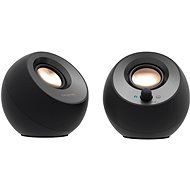
Creative Pebble V3 - black
In stock > 5 pcs
31.90 €
Add to Cart

Tomáš, Praha 9
Rated 30/09/2026, variant Creative Pebble V3 - black
Verified purchase
I had to return these speakers because I couldn't get them to work with my computer via USB. I have a fairly high-end PC, but no matter what I did, the speakers just wouldn't connect correctly. I tried USB-C, the included USB-A adapter, a different USB-A adapter, and another cable. Nothing worked. I found a number of similar experiences on Reddit, where one of the tips was to update the firmware, but that's also done via USB, and although the speakers themselves went into firmware update mode, the app acted as if it didn't detect them. A soundbar from the same manufacturer works, although its app for adjusting the equaliser etc. also doesn't work. This manufacturer has an interesting price/performance ratio on the hardware side, but the software side is a tragedy.
0 ×Report
Automatic translation

Oskar, Teplá
Rated 26/09/2026, variant Creative Pebble V3 - black
Verified purchase - review from a price comparison website
Sound quality
3 connection options
Ideal for a laptop
0 ×Report
Automatic translation

Radka, Hradec Králové
Rated 06/08/2026, variant Creative Pebble V3 - black
Verified purchase - review from a price comparison website
The headphones are small - which is what I was looking for, and the sound is fine. They have a clear and powerful sound.
0 ×Report
Automatic translation

Marie, Praha 8 - Střížkov
Rated 05/08/2026, variant Creative Pebble V3 - black
Verified purchase - review from a price comparison website
Quality sound
Easy to use
Favourable price
Modern design
0 ×Report
Automatic translation
Miroslav, Tuchlovice
Rated 23/07/2026, variant Creative Pebble V3 - black
Verified purchase - review from a price comparison website
Perfect for a PC, both in terms of size and sound
0 ×Report
Automatic translation
Jana, Týn nad Vltavou 1
Rated 22/07/2026, variant Creative Pebble V3 - black
Verified purchase - review from a price comparison website
Easy to connect to a PC; the cable length is just right for me
they look nice
They play well, and are easy to control
Great for the average PC user
good price
0 ×Report
Automatic translation

Jan, Náchod 1
Rated 11/07/2026, variant Creative Pebble V3 - black
Verified purchase
Without electricity. power supply (via USB-C)
I play very cleanly
Turning off using the volume button
They could be cheaper: -)
0 ×Report
Automatic translation

Jana, Břeclav
Rated 01/07/2026, variant Creative Pebble V3 - black
Verified purchase - review from a price comparison website
nothing
0 ×Report
Automatic translation

Martin, Třeboň
Rated 16/06/2026, variant Creative Pebble V3 - black
Verified purchase - review from a price comparison website
Does not need power supply
Decent sound
They’re a bit bigger than they look in the photos
0 ×Report
Automatic translation
Jiří, Cheznovice
Rated 27/05/2026, variant Creative Pebble V3 - black
Verified purchase
Good sound
Reports as an audio device even over USB, so no need to plug in the jack
When switched on they check the Jack, then the USB and if nothing is connected they switch to BT automatically.
0 ×Report
Automatic translation